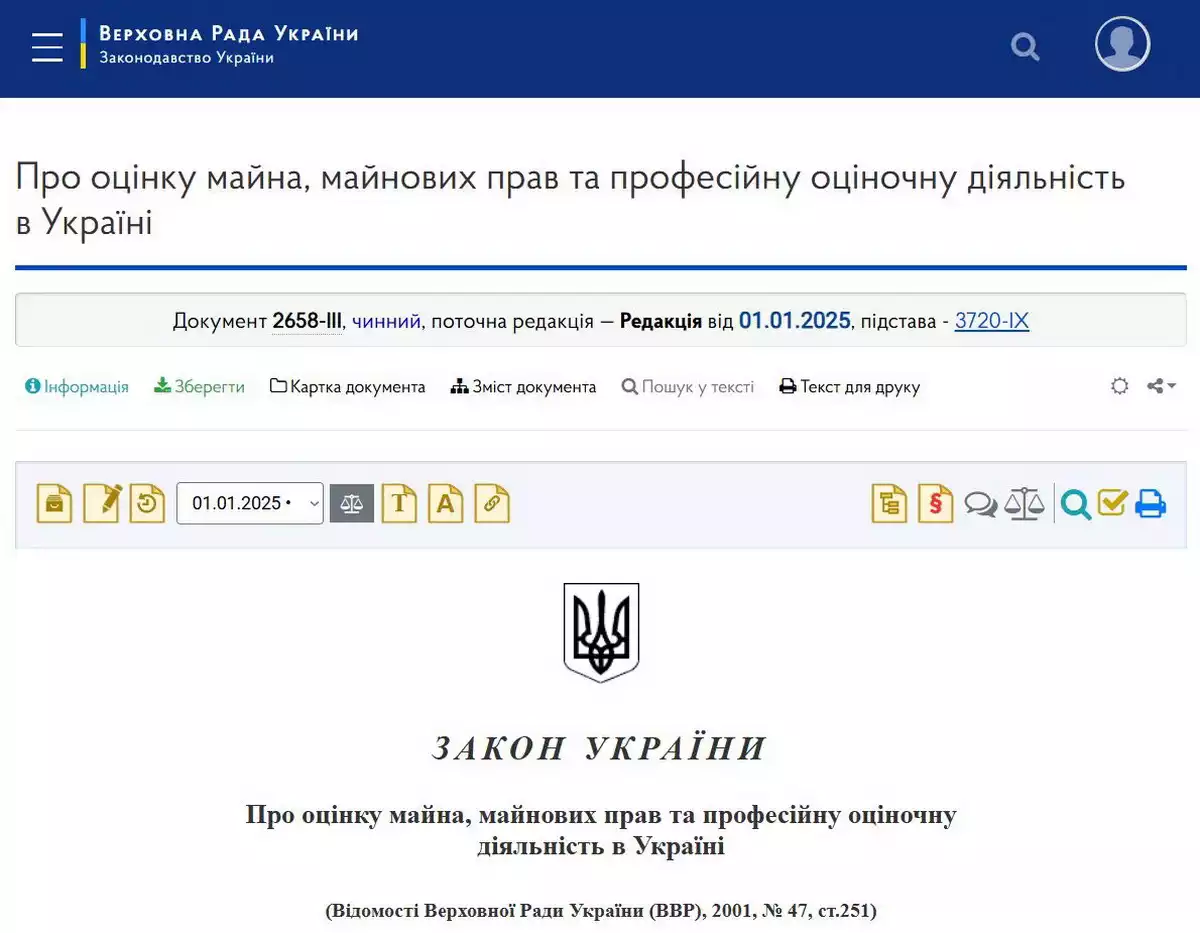
Official text of the Law of Ukraine “On Property Valuation, Property Rights, and Professional Valuation Activities in Ukraine” on the website of the Verkhovna Rada of Ukraine.
Property valuation in Ukraine is regulated not only by the practice of appraisers or internal company standards. The main legal act that defines the rules for conducting valuations, the rights and obligations of the parties, and the requirements for the appraiser’s work results is the Law of Ukraine “On Property Valuation, Property Rights, and Professional Valuation Activities in Ukraine”.
Most clients encounter property valuation only a few times in their lives—during real estate sales, inheritance procedures, court cases, lending, or accounting processes. Therefore, many important provisions of the Law remain “behind the scenes”: a person receives the final report but does not always understand the rules behind its preparation and the legal requirements it must meet.
In this article, we will not review the Law from the professional perspective of appraisers. Instead, we will focus on those provisions that have practical significance for clients—i.e., property owners, lawyers, accountants, and anyone using valuation results.
Knowing the basic norms of the Law allows the client to:
- understand when a valuation is legal and can be used officially;
- verify that documents are properly executed;
- avoid situations where the report might be rejected by a notary, court, or government agency;
- distinguish a professional valuation from unofficial “cost calculations”.
Next, we will examine the key provisions of the Law.
Article 4 of the Law: Forms of Professional Activity and Requirements for Appraisers
Article 4 of the Law of Ukraine “On Property Valuation, Property Rights, and Professional Valuation Activities in Ukraine” defines the specific forms in which professional valuation activities may be conducted. For clients, this is an important point, as not all appraiser work is limited solely to preparing a valuation report.
The Law provides for several types of activities:
- practical property valuation activities — direct performance of valuations and compliance with all procedures according to regulatory requirements;
- consultancy activities — providing oral or written advice to clients, valuation entities, or other parties;
- reviewing valuation reports — checking already prepared reports for accuracy, completeness, and compliance with legislation;
- methodological support for valuation — developing methodological materials and explanations on their application;
- educational activities — participation in training and professional development of appraisers.
For an ordinary client, the most important of these is consultancy activities. The Law explicitly allows appraisers to provide written and oral consultations on property value matters without preparing a full valuation report.
This is practically significant in situations where preparing a report is impossible or impractical. For example, when necessary documents are missing, there is no access to the property, or the person has no legal grounds to commission a valuation. In such cases, a written consultation can serve as a professional explanation of property value, including for preparing a position in legal disputes.
Thus, Article 4 effectively expands the client’s options: the appraiser can assist not only with an official report but also with a professional expert opinion in consultation form.
Another important point often misunderstood by clients is also contained in Article 4 of the Law. In everyday life, people commonly say “the appraiser did the valuation,” but legally it is a bit more complex.
The Law establishes that professional valuation activities are conducted not simply by appraisers as individuals, but by valuation entities (VEs). Such entities may be:
- legal entities (companies);
- individual entrepreneurs.
An essential condition is that the entity must employ at least one appraiser with a valid qualification certificate.
This implies an important point: an appraiser acting independently, outside a VE, is not authorized to sign a property valuation report. Even if the person has many years of experience and qualifications, without the status of a valuation entity the report will not meet the Law’s requirements.
For clients, this is a practical signal: if someone offers you a “valuation without a contract from a private appraiser,” there is a risk that such a document will have no legal force and will not be accepted by a notary, court, or government agency.
That is why a proper report always includes not only the appraiser but also the company or individual entrepreneur—the valuation entity on whose behalf the work is performed.
Valuation Is Conducted Only on the Basis of a Written Agreement (Articles 10 and 11)
Article 10 and Article 11 of the Law establish one of the key guarantees for the client — property valuation can be conducted exclusively on the basis of a written agreement.
In practice, this means that verbal agreements, messenger correspondence, or even an issued invoice do not replace a full agreement. Without it, conducting a valuation contradicts the requirements of the law.
The Law also defines essential conditions that must be specified in the agreement. In particular:
- the object of valuation;
- the purpose of the valuation;
- the type of value being determined;
- the date of valuation;
- the timeline for performing the work;
- the rights and obligations of the parties;
- the procedure for payment of services.
For the client, this is not a formality but a protection of their interests. The agreement defines the purpose for which the valuation will be used. If the purpose is stated incorrectly (e.g., “for internal use” instead of “for court” or “for notarial purposes”), the document may simply be rejected at the submission location.
Therefore, professional appraisers always clarify where the report will be used. These are not unnecessary questions but compliance with the Law’s requirements.
Who Can Be a Client of a Valuation (Article 11)
One of the Law’s provisions, known to far from all clients, is explicitly stated in Article 11: only persons who own the property or legally possess it can be clients commissioning a property valuation.
In other words, it is impossible to order an official valuation of someone else’s property.
A client may be:
- the owner or co-owner of the property;
- a person legally using the property;
- a representative of the owner under a power of attorney.
This rule often surprises clients, especially in court disputes, family conflicts, or during preparation for property division. A person may want to know the value of the object in advance, but legally has no right to order the report.
In such cases, the mechanism provided by Article 4 of the Law comes into play — the appraiser can prepare a written consultation regarding the likely value of the property instead of an official report.
This allows obtaining a professional opinion from a specialist without violating legal requirements and often serves as the first step before further legal actions.
Valuation Result: Appraiser’s Report (Article 12)
Article 12 of the Law clearly defines that the result of conducting a property valuation is the Appraiser’s Report. This is an official document with legal force containing a detailed description of the object, valuation methods, and a conclusion on its value.
For the client, several key points are important:
- The report is signed by two persons: the appraiser and the head of the valuation entity (VE), even if this is the same person.
- The document contains all mandatory details: information about the object, the purpose of the valuation, the valuation date, the applied methods, and the value conclusion.
- The presence of signatures and correct execution guarantees that the report will be accepted by a notary, in court, or by a government agency.
For the client, this means: even if the appraiser is experienced and qualified, without compliance with formal requirements and signatures, the document has no legal force.
Valuation Review: Checking by Another Appraiser (Article 13)
Article 13 provides for the procedure of reviewing a valuation report. This is the verification of an already prepared document by another appraiser to confirm accuracy, completeness, and compliance with legal procedures.
Reviewing is applied in two key cases:
- for transactions with state or communal property, such as sales or leases;
- in court disputes when one of the parties disagrees with the valuation provided by opponents;
For the client, this is a guarantee of additional verification and reduced risk of errors in the report. Often, government agencies or banks require a review to confirm the correctness of the valuation, especially for large objects.
The review procedure not only increases trust in the document but also serves to protect all parties in the transaction, ensuring transparency and legality of the valuation process.
Documents Confirming the Right to Conduct Professional Appraisal Activities (Article 15)
Article 15 of the Law establishes that an appraiser conducts professional activity on the basis of a qualification certificate. This is an official document confirming the person’s right to perform property valuations and carry out all related procedures.
Key points for the client:
- The certificate is valid for two years from the date of issuance.
- The certificate is issued after passing the required exams and confirming professional competence.
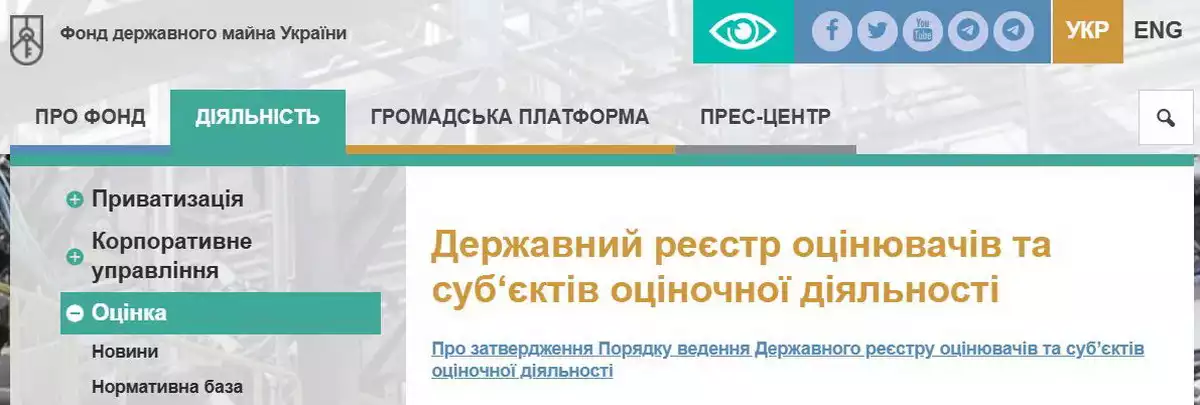
- You can verify the validity of the certificate in the public register of the State Property Fund of Ukraine.
For the client, this guarantees that a qualified person conducts the valuation and that the report will have legal force.
Documents of the Valuation Entity (Article 19)
Article 19 of the Law provides that a company or private entrepreneur (FOP) employing appraisers must have a Valuation Entity Certificate. This confirms that the organization or individual entrepreneur meets all requirements to provide valuation services.
Important details for the client:
- The certificate is issued for a period of three years.
- It confirms that the entity employs at least one qualified appraiser.
- The certificate allows verification that the valuation entity (VE) is authorized to sign official reports.
This is another layer of protection for the client: without the VE certificate, an official property valuation cannot have legal force.
Register of Appraisers and Valuation Entities (Article 22)
Article 22 establishes that the State Property Fund of Ukraine maintains a register of appraisers and a register of VEs. For the client, this is a powerful tool for verification and control.
On the SPFU website, you can check whether an appraiser holds a valid qualification certificate. Information about the VE is also available, including the certificate, issuance date, and validity period.
This allows the client to ensure that the document they receive will be legally valid and accepted by a notary, court, or bank.
For the client, the presence of the register reduces the risk of fraud and errors, since any appraiser or VE conducting a valuation without the proper documents is violating the law.
Inspection of the Valuation Object: When It Is Mandatory (Article 31)
Article 31 of the Law emphasizes that appraisers are required to conduct an inspection of the valuation object. This is one of the key points for the legal validity of the report. If the inspection is not conducted, the report may be deemed invalid.
The inspection includes:
- visual examination of the property;
- assessment of the object’s condition;
- recording all characteristics affecting the value.
If it is impossible to conduct the inspection (e.g., due to lack of access or quarantine restrictions), professional appraisers may prepare a written consultation based on Article 4 of the Law. This allows obtaining an estimated value assessment without a formal report while still complying with legal requirements.
Summary for Clients
In summary, it is important to emphasize that we have only reviewed those articles of the Law that are key for clients and users of valuation services. Main takeaways:
- Professional valuation is carried out through valuation entities, not by an individual appraiser.
- Valuation is conducted only on the basis of a written agreement specifying all essential conditions.
- Only owners or legally entitled persons can be clients.
- The appraiser’s report has legal force only if signed by both the appraiser and the head of the VE.
- Appraiser consultations allow obtaining a professional value assessment without a full report when necessary.
- Inspection of the object is mandatory, and the SPFU register and certificates ensure the legality of actions by the appraiser and the VE.
For the client, following these rules guarantees that the valuation will be valid, accepted by a notary, court, or government agency, and any legal risks are minimized.